In Part 1 of How to Read Music like a Pro, I talked about what sight reading is, why it’s important, and why it’s a common challenge for many musicians.
In Part 2 of How to Read Music like a Pro, I mentioned the most common sight reading books used by teachers, and how to choose the material that is right for you.
In the 3rd and final part of How to Read Music like Pro, I will give you tips on how to successfully sight read material.
Now that you have determined your sight-reading ability and chosen material that is right for you, it’s time to play!
In an exam, you will get some time to look over the passage before you play. Even if you play for a choir, you should have at least a few moments to look over the music you will be playing. Use this time wisely by preparing…
Preparation:
1. Look at the key signature and remember what keys are altered with a sharp or flat!
2. Also related to point #1, find out what KEY you are in. This will help you greatly because if MAJOR key, should sound generally happy and positive, if MINOR key, should sound sad and the leading notes will VERY LIKELY be raised
3. Scan the entire passage for what appears to be the most challenging part (ex. changing clefs, complex rhythms, accidentals, pedaling, changes in fingering, etc.)
4. Look for patterns, such as sequences (a motive or musical idea repeated at a different pitch), chords, scales, etc.
5. Notice articulations (anything other than notes) such as staccatos, dynamics, slurs, ties, and other markings
6. Secure the beginning and ending of the passage (this will boost your confidence when you play)
MY BIG HINT: Most music feature A LOT of repetition, whether it be rhythmic or intervallic (ie. a pattern may be repeated at a different pitch). Every sight reading exercise I have encountered from teaching books have some kind of pattern that can be discovered! You just have to find it! For example, look at the passage below from Paul Harris’ Improve your sight-reading! Piano: Level 5:

Looks complicated, right? The worst thing you could do is think, “I have to find and play all those individual notes!” Don’t make it harder for yourself! Check out what I see:
 Purple: This is a sequence (the rhythm and intervals remain the same; the only change is the pitch). Since the pattern moves one note down, you may not be able to reach all the notes in the second group, so be on the lookout to change your hand position, or alter your fingering (see how they suggest putting finger 2 on C sharp?)
Yellow: These are exactly the same
Green: This is the tonic broken chord of D major arranged in Alberti Style, and repeated 4x
Blue: This is the dominant 7th (a chord created from the fifth note of the scale) broken chord of D major, also arranged in Alberti style and repeated 4x
Last two bars: A perfect cadence in the key of D major
Realizing these patterns requires some analysis, so it’s helpful to have a basic understanding of music theory. This will greatly help you no matter what instrument (including your voice!) you use.
It’s Showtime:
1. The Golden Rule of Sight Reading (see below)
2. Start slower than what you think you should (most players begin too fast)
3. Don’t think about the names of the notes as you play – instead, you should be counting steadily in your head to maintain a steady tempo.
4. Try not to look down at your hands at all – use your peripheral vision as much as you can, and only glance down quickly if you must move your hands a far distance
5. Play with as much confidence as you can muster – believe you can do it!
The GOLDEN RULE OF SIGHT READING: Never stop playing!
Playing steadily without stopping > Playing all the right notes
Sounds simple enough, but it runs counter intuitive to how we practice the piano. We have an instinct to try to fix or correct whatever we know we made a mistake on. But what examiners (and your band or duet mates are looking for) is someone who can keep on playing without missing a beat.
Tip: when beginning to sight read, you may use a metronome to help you keep the beat consistent. This might stress you out in the beginning but it really is the best tool you have on your keyboard to help you keep a steady beat
So what should you do if you make a mistake (ie. something sounds “funny”)?
1. Ignore it and keep going
2. Focus on the material ahead – it’s too late to change anything you’ve done, but you can still complete the remaining material as best as you can
3. Do a quick mental check to see if you forgot the key signature or to raise the leading note in a minor key
3. If you can’t find a note quick enough, fake it and play a note near where you think the note should be
I end with this Confucius quote : I hear and I forget. I see and I remember. I do and I understand.
After all the tips and ideas, the only way to improve your sight reading ability is to practice it a lot! (like weight loss, there is no quick and easy solution!). Great sight readers are those who have practiced and worked on it consistently and patiently. The only question is, are you content to be”okay” at sight reading, or do you want to be a master sight reader?










 Four Star Sight Reading and Ear Tests by Boris Berlin for each level from Introductory to Grade 10. They are arranged daily, you can complete one sight reading exercise a day. This is the standard examiners are looking for if you’re playing a Royal Conservatory Exam.
 Practical Sight Reading Exercises by Boris Berlin and Claude Champagne.
 Complete Series of Sight Reading and Ear Tests by Bennett and Capp have graded levels from 1 – 10/ARCT. I find this series to be slightly more difficult than Four Star, and go up to the ARCT Level (highest level).
 Sight Reading by James Bastien.These are used for beginner piano students as the levels only go from 1-4.
 A Line a Day by Jane Smisor Bastien. (If her last name looks familiar, it’s no coincidence. She is the surviving wife of James Bastien (he passed away in 2005) and when he was alive, they performed as duos and wrote method books for piano students.). Her books range from Level 1 – 4 and are a more updated version from her husband’s, and feature literally one line a day you can play.
 Basic Piano Course: Sight Reading by Gayle Kowalchyk and E.L. Lancaster. For those students following the Alfred method books, levels 1A – 6.They contain cute illustrations (great for young beginners) and tapping and playing exercises.
 Piano Adventures Sightreading Book by Nancy and Randall Faber. Faber and Faber have sightreading books that correspond to with their popular Piano Adventures Series, but so far only Primer and Level 1. Level 2A and 2B (and I assume eventually all their levels) are coming soon.
 I Can Read Music – A Notespeller for Piano by Nancy and Randall Faber. Only 3 books: Beginning, Elementary and Early Intermediate levels.
 Improve your Sight-Reading! Piano by Paul Harris. Harris has written sight reading books for many instruments including piano, flute, violin, and cello. Levels 1 – 9. I like how he includes a practice chart, and reminds the player to remember the importance of conveying the musicality and character of the piece. This is important because if we neglect this, we are just typing, not playing music.
 Sight Reading and Rhythm Everyday by Helen Marlais, Kevin Olsen, and Julia Olsen. There are only 11 books, and not graded according to the traditional piano levels in Canada. However, this is one of my favourite books because it focuses heavily on rhythm and is arranged in a way that the learner can systematically incorporate key signatures, intervals, and patterns.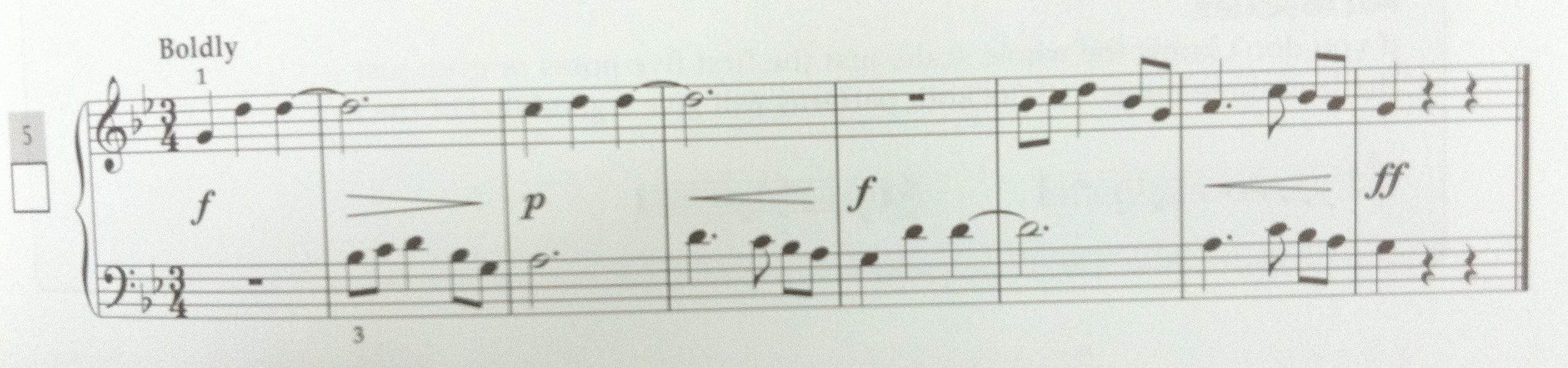
 Hannah's Piano Studio