Hi everyone! Sorry it took me awhile to upload and edit the June 2012 concert, but they’re finally up! Quality isn’t awesome and I’m sure many of you had better photos. You should have the password from the concert, and if not, you can contact me for it.
For those students who are traveling or taking a break during the summer, best wishes and safe travels! I will still be teaching over the summer, taking the last week of Aug and first week of Sept. off. (NOTE: updated lesson fees begin Sept. 2012)
(I will be continuing the posts on “The Inner Game” in a few days)
On Saturday, June 2, I was fortunate enough to get tickets at the Orpheum Theatre for the highly publicized young pianist, Jan Lisiecki. At only 17 years old, he has already accomplished many things: an orchestral debut at 9 years old, performed over a hundred times with an orchestra, played at Carnegie Hall, and with many of today’s top musicians, and has released two CD’s.
Sitting in the front row, the excitement was palpable. Eavesdropping among my neighbours, many had come to see Lisiecki perform. The program for the evening: An original piece by composer Richard Mascall, a piano concerto by Robert Schumann, and Richard Strauss’s Ein Heldenleben.
At 7:05pm, there was a free pre-concert talk by Edward Top (VSO’s composer in residence) and Richard Mascall, a composer from Eastern Canada. Top gave a quick overview of Ein Heldenleben and the piano concerto, while Mascall introduced his original work, “Manitoulin”. Mascall explained that he was inspired by the Ojibwey people in Manitoba, and had spend much time researching the Aboriginal people’s music and culture. As a result, Manitoulin was influenced by various Aboriginal sounds and rhythms, such as the pentatonic scale, or use of the rainstick to evoke the sound of the breeze rustling the leaves in the forest.
After a brief break, the Vancouver Symphony orchestra took the stage at 8:00pm. I have never sat in the front row at the orchestra before, and it was a huge treat! I could see all the front musician up close, and could even hear them take a breath before playing a musical phrase! Violinist concertmaster Dale Barltrop played the violin solos with brilliance and feeling, and I found myself also moving and swaying with the music.
When Jan Lisiecki took the stage, he strode in with conductor Bramwell Tovey. He was much skinnier and taller in real life. Lisiecki was dressed impeccably, and his shoes gleamed in the light. His skin was flawless and his hair was as coiffed as the pictures. He is known for his technical brilliance, and I was impressed. I imagined what it would be like to be playing up there on stage, and to memorize everything and not have any slip-ups. To play in front of a critical audience. I wondered how he dealt with the pressure of performing and if he employed any of the techniques in the Inner Game of Music?
It’s clear that as a young pianist, he still has some growing and maturing to do. I was a little disappointed at the opening of Schumann’s piano concerto (it was supposed to open with a “bang”), but as he played, he seemed to gain more confidence. By the end of the 3rd movement, he seemed to be enjoying himself more, and the piece finished strongly. After his performance, he received a standing ovation by over half of the audience, and came back to play a Bach prelude encore.
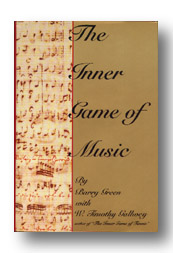
This is the first of a series of blog entries about the techniques and tips from “The Inner Game of Music” by Barry Green and Timothy Gallwey. I have summarized the findings from this book – personal thoughts will be in brackets. The author’s website can be found at http://www.innergameofmusic.com .
The Performance of an individual can be neatly summarized by the following formula:
P=p-i
P = Performance, p = potential, i = interference
The lower the interference, the more our inner potential is reflected in our performance.
Have you ever imagined what it would be like to learn a piece at home, and then to play it perfectly in front of an audience? How about doing this while not getting distracted by your thoughts or doubt or anxiousness?
Realistically, who hasn’t felt a measure of nervousness when performing in front of someone else? Some people feel so nervous before a performance that they feel physically sick. Others doubt whether they’ve memorized the piece, even though they may have practiced 200 times. As we learn how to play a piece, our teachers instruct us on the correct notes, the proper hand technique, and various physical ways to create a beautiful sound. But they rarely touch on what is equally important – what happens to the performer mentally, or internally.
By the time a performance opportunity arrives, the musician has already put in hours of practice and work on their own. But the final obstacle is the inner battles raging within you: self doubt, nervousness, anxiety, the pressure to please family, friends, and yourself.
This book compares musical performance to a game, and shares effective methods to “win” this game by overcoming such internal conflict.
1. Identify Self-InterferenceExercise 1 (do this!): Take a moment to think about and make a list of what makes you nervous about going on stage. Next, list the mental and physical effects that doubt and anxiety have on you.
Common answers include: “I feel I haven’t practiced enough“, “I’m worried I might lose my place in the music“, “I don’t think the audience will like my playing“, “what if I forget what I’ve memorized?”. Common physical and mental effects include: dry mouth, shaky/clammy/sweaty hands, feeling sick to your stomach, feeling tense, can’t breathe, losing concentration, inner voice blaming self, etc.
That voice in your head giving you all these ideas (let’s refer to it as Self 1) is talking to someone (Self 2). Both “selves” are in you.
Self 1 is our interference – it often talks to us in “should” and “shouldn’t” and “could’ve been” – loves to predict future failures and successes – it can include our personal thoughts or ideas, as well as others, including our teachers, parent’s expectations, friends – is critical
Exercise2: Identify Self 1 – while reading this blog, notice any chatter going on in your head, and speak it out loud, and then speak it aloud. Notice when your mind wanders and how this affects your reading. Did you need to re-read? Your self 1 is your inner commentary.
As children, we learn to walk and talk, and speak without interference (this explains why children pick up new skills such as swimming or skiing faster and easier than adults). Then, as we grow older, we begin to collect ideas, attitudes and concepts from our environment, and slowly this begins to affect the way we learn. What we had previously been able to absorb spontaneously and openly begins to close, and learning about this interference will help us regain this natural ability.
Self 2 is our potential (natural talents and abilities)
– vastly unlimited and performs on its own with grace and ease – contains all our past musical experiences and knowledge, even that which was not taught – involves our entire nervous system, and what our body has learned through automatic and instantaneous feedback circuits
Basically, Self 1 is anything that interferes with our potential and Self 2 is anything that expresses our potential. Green encourages us to be aware of Self 1 and how and when it interrupts Self 2. Teachers, parents, our friends and peers may have instilled some doubts and fears in us when they tell us what we “should” be doing. The problem is when we internalize these doubts and fears, and let them take over or mind and focus while we are playing
However, we can CHOOSE not to listen to our Self 1, and when our mental and physical hindrances are gone, our performance can truly reflect our potential. This brings us to the second important step: Ignorance
2. Ignore Self 1 Have you ever had a persistent child ask you for something while you are busy doing something else? Or listened to the constant tick of a clock in a quiet room until it becomes all you hear?
How do you resolve this? Either you remove yourself from the situation, or choose to ignore it.
Although our Self 1 may talk to us constantly, we have the choice to pay attention to it or not. We can tune into it, or ignore its attempts to get our attention. The purpose is to get us to our ideal state, which is relaxed, alert, and focused. We are fully concentrated in the present moment, and are enjoying ourselves.
When we achieved our ideal state, we have the “master skill” of the game. If we cannot remove ourselves from our inner voice, how do we ignore it? Next time I will talk about 3 game skills (AWARENESS, WILL POWER AND TRUST) that will help in mastering how to ignore your inner voice as well and how to cope with your inner fears and doubts.
Some of you may be familiar with the “Inner Game” books by Timothy Gallwey. His books focus on ways to win the “game” whether it’s for work, sports or music.
Gallwey believes there are two factors that affect your performance : your potential and your interference. Simply put, your potential is your innate talent or ability, while interference is anything that hinders your potential.
This interference is mental, or internal – it’s the voice inside your head whispering doubts and causing you anxiety.
Who hasn’t worried before an final exam whether you have studied enough, whether you remember anything at all! Who hasn’t had nightmares of discovering that you have completely forgotten everything and all you can do is stare blankly at the words on the paper?
Similarly, who hasn’t suffered some sort of performance anxiety when playing a piece or singing a song in front of an audience? No matter how much you may have prepared, practiced, and memorized, every musician has experienced moments where they fear they will let everyone and themselves down by failing the performance, or fumbling on their solo, or losing their place in their music.
These fears can be disconcerting, and sometimes crippling. What can you do about this inner war, and how can “win” by playing without any interfering thoughts?
The Inner Game of Music by Barry Green and Timothy Gallwey suggests helpful and practical tips to help any musician perform to the best of their ability by ignoring, decreasing, and eliminating this internal interference.
Over the next couple of weeks, I will be posting suggestions and explanations to the book as it relates to musical performance, and hopefully this will be helpful to those who are anticipating near future performances or recitals.
I also look forward to your comments and any suggestions!
Many scientific studies have shown how learning how to play a musical instrument improves a child’s personal and social development. Music students tend to score higher in subjects such as math, and tend to be less disruptive in classes (see http://www.encoremusiclessons.com/benefits-of-music-education/success-in-school)
However, student drop-out is often a reality. Theresa Chen has an excellent blog post on how she sees students as going through 6 stages, with the 5th stage being the one when most students drop off. She’s included a helpful diagram here:
I agree with her perspective, and personally, I found piano the most difficult during my high school years, and it wasn’t until I was 15 or 16 when I had to volunteer as part of my Gr. 12 graduation that I started to really enjoy playing the piano for myself. This is my story:
Every student in grade 12 had to complete a number of volunteer hours in order to graduate. I thought I would pursue medicine, so naturally, I sought a position at St. Vincent’s hospital. At first, I was instructed to help in the geriatric wing, where I would serve the patients tea or coffee, and other refreshments, and talk to them or keep them company. I enjoyed doing this, and had many engaging conversations with the seniors and their family members. Eventually, this ward was closed down due to budget cuts, so I was assigned a new position at a different hospital, but also in the residential care facility for the elderly.
The volunteer coordinator looked over my resume and realized that I could play the piano! So I was assigned to play piano for about an hour to the residents. She dug up a binder full of music from the 20’s-70’s and suggested I play those tunes because the residents would find them familiar and enjoy them. I hesitantly agreed, and went home nervously. I decided to check out the local library to see if they had any music book collections, and I was pleasantly surprised to see that they did! Long story short, this was my introduction to new music, stuff that I had never heard before, but the more I learned and played the pieces, the more I enjoyed the sounds from this era, and the more inspired I was to continue to learn music!
In short, during the “downs” in my years of piano study, what helped propel me were several factors:
-supportive but firm parents. My parents changed their approach as I grew. In the beginning, my home practice was regimented, and there was a time that I had to sit down to practice. My mom sat beside me, and helped point out the notes, or just made sure I was following my teacher’s notes in my book. As I grew up, my mom no longer sat beside me or scheduled my practice time, but she did ensure they happened regularly. Practice was something that had to be done as part of our day
-an understanding piano teacher – we used to have lessons every week, but as I became more busy with schoolwork, he agreed to let me come for an hour, every other week. This allowed me to continue piano lessons while focusing on my increasing school workload
-discovering new music, and learning it on my own, for myself. I realized that my music education was limited to the repertoire my teacher was familiar with, but there are many other genres of music and that it was very exciting to find out what kind of music resonated with me
One of my piano teachers once told me this story about his two sons:
This piano teacher and his wife both taught music. They had two sons, so naturally, both sons grew up in a musical environment.
The elder son he forced to practice and complete an exam in practically every level of piano. This son grew up attaining high marks in piano, alas, never returned to the piano after completing his final exam. For his second son, the father changed his approach: instead of forcing his second son to take every exam, he allowed his son to play different pieces and have more freedom. In fact, this son ended up only taking one exam – the highest level. He passed with flying colors. But what is most interesting is that this second son attended a music camp one summer, where he was inspired by his peers. He began buying music from stores and listening to great performers, and listening to which performers played brilliantly, and which performers played mediocre performances. This further motivated him to continue his musical education, and he did – completing a Bachelor and Masters in music at Julliard and is now an amazing concert pianist touring the world, by the name of Ian Parker.
I’m writing this blog to encourage all music teachers and parents out there…don’t give up because the final payoff is worth it! If someone is not working out because the teacher is not a good fit with the student, or because a child is too heavily scheduled in activities, or there are too many other distractions, it is possible to make a change in order to preserve the student’s continuation in music lessons.
Continued from the previous discussion on practicing…
This blog focuses on the PARENT:
2. The Parents
Although the teacher is the main motivating force, the student only sees the teacher once a week for 30-60 minutes at most. It is impractical to assume the teacher alone will be the driving force for a student’s daily progress.
The parents/caretakers are the ones who see their child every day, and must work with them during the week. Without supportive parents, the child faces a huge impediment on the road to success.
Parents have many reasons for enrolling their child. Depending on culture and background, some parents want their child to learn piano because THEY had to learn piano as a child, and it’s just another skill, like swimming or skating, that every child must possess. Other parents (I find most parents are this type) just want their kids to learn something that will be fun and useful and be able to perform something at whim. And finally, some parents put their kids in piano, as a sort of babysitting service – “teach my child something but it’s not really important if they progress or not”. These are the worst kind because they think practice will happen “on its own” or “if my child wants to learn the piano, they’ll be self-motivated to practice”.
Essentially, it is the parent’s attitude and attention that largely determines their child’s progress.
The most important aspect of a parent’s attitudes toward learning the piano is their EXPECTATIONS.
Expect a long-term commitment:
Many parents expect their child to simply learn at the lesson and continue to practice that on their own at home. In fact, learning the piano or any instrument requires long-term commitment. Remember last week how I wrote that most kids are in it for the short-term goals (able to play a piece immediately?). This long-term commitment requires DAILY practice and results are almost always not instant.
Expect natural feelings of highs and lows
And it’s precisely during those “lows” that a child needs his/her parent to be their cheerleader…to persevere even though it may not feel great or want to practice. Do we expect our Canucks hockey team to do well (hey they got the President’s Trophy again this year!) and to eventually win the Stanley cup WITHOUT hours and hours dedicated to practice? Even Jeremy Lin, 2012’s breakout basketball star spent hours a day working out, eating right, and throwing hoops again and again before he became a basketball sensation. What if he didn’t feel like practicing because he was tired or felt bored, or didn’t make much progress? These are feelings that one sometimes has to work through, to attain greatness.
Expect daily practice
Can we expect much progress from a child who practices once or twice a week? Yet I’m told by at least one parent nearly every week, that this is precisely what happens. I had a couple of students last year whose parents informed me at the beginning of nearly each lesson that their child had not practiced during the week. Both of these children were under the age of 7! Clearly, these parents were lacking in time management skills, or had enrolled their child in too many after-school activities!
When practice doesn’t happen, progress doesn’t happen, and when progress doesn’t happen, a student will beg to quit, or the parent will cease lessons because they are a waste of money.
Expect a routine
Related to the above point, daily practice will only occur if it’s within a daily routine.
Parents are responsible for setting up a routine for their child. Much like brushing their teeth or cleaning their room, practice must be a part of their child’s day. When practice is shoved after school homework, chores, dinner, watching TV, etc. no wonder it never gets done!
Expect to show some interest
Practice is can be especially challenging for extroverted personalities that crave and need interaction with other people. Parents may not realize that practice can be an extremely lonely task. They tell Junior to practice, while they do other things or worse yet, watch TV or read a book, leaving Junior alone to practice by himself! Although some children do not like their parent to sit beside them while they practice, many appreciate it when they know their parent is listening in the next room (door open) or listens to the last 5 minutes of their practice. Sometimes, the child needs to know that the parent is with them and is also taking time out of their busy day to focus on playing the piano.
Expect communication
Parents should also communicate with their child on a daily basis, and to maintain open communication with the teacher.
Discuss with your child how their progress is going. Talk about what was a challenge today and what they think they did well on.
Try to discuss any issues with the teacher privately, never in front of the child! This causes embarrassment and a sense of discouragement. Last year, I had a frustrated parent, who told me on the very first day of lessons that her son was not very good at piano, and only wanted her son to play so that he could develop that skill. Needless to say, from that parent’s attitude, the son already presumed he was no good, and during the course of the year, put in minimal effort, and quit at the end of the year!
Expect Fun!
I spoke with a long-time music teacher, and she NEVER says to “practice” the piano. Instead, she asks her child or student if they have “played” the piano. This completely changes the focus from something that is difficult and lonely, to something that is fun – playing! Examine your tone of voice – is it harsh and demanding, or is it encouraging and charming? Sometimes a firm stance is required, but are you acting as their cheerleader or bully (ie. “do this or else!”).
Next week I will discuss the times when a student is MOST LIKELY to drop out of lessons, and what you can do about it.
Also, a story of a parent who took two approaches, resulting in two very different outcomes!
How many times have parents heard that phrase, as they exasperatedly prod their child for what seems like the hundredth time in the day.
Sometimes, as parents or teachers, we wonder why our child is not more grateful of all the time and money we have spend on their piano lessons. Why they get bored and would so much rather go do anything (even chores sometimes) instead of honing their skills as budding Mozarts!
Growing up, my sisters and I had to take music lessons – specifically, piano lessons. Yes, they were painful at times! And sometimes practice time was used as punishment ! (Ex. when we stayed up past our bedtime chatting instead of sleeping, we were threatened with having to practice the piano because we were so “awake”!)
Of course, that was the exception – we mostly got our practice done with only some minor grumbles.
Now that I have grown to love playing and teaching piano, I believe my attitude toward practice has changed slightly. Although it is extremely important to put in the effort during the week to work on your pieces, I believe the teacher, parents and the musical environment of the child are extremely important in motivating a child to practice, and make the difference between a child who drops out within a few months to a year, to a child who grows up loving the piano, even if he/she will never become a concert pianist.
I will be writing three blogs on three important aspects of motivating a child. Read when you have time, and thanks for reading! I welcome any thoughts or comments 🙂
1. The Teacher
This is the first point, because it is also THE most important aspect of a child’s experience with the piano. The unfortunate thing is that piano teachers tend to teach based on the way THEY were taught as students. And sometimes things that worked back then don’t work now. Kids in this time (2000’s and beyond) value instant gratification and familiarity. They want something to be rewarding NOW and want to have FUN doing it.
When I attend workshops on how to “tame the practice monster” or how to inspire kids to practice, inevitably, the number one response from teachers is that their students just want to have FUN!
The problem is that those attitudes were not valued or entertained when we were learning music as children. I’m sure people in an older generation than I can recall horrific teachers who would yell or become visibly angry or even hit their hands or wrists! As a result, many teachers have to adjust their approach, from the way they were taught, to a way that is more effective for the present; from a disciplinarian to a c0-explorer or mentor in music.
It’s my job as a teacher to inspire and also motivate my students to practice. 99% of students who begin piano lessons will not become a concert pianist. But many teachers instruct their students as if 99% of them will become professional musicians (not taking the time enjoy making music)! Therefore, I am striving to make lessons informative and helpful, but also inject fun and enjoyment.
Kids LOVE to imitate or play tunes that they know or are familiar with. You don’t know how many times I’ve been asked to teach them the latest Bruno Mars, or LMFAO, or Katy Perry or Adele songs! And they love learning these tunes!
However, since I may be the first person to expose them to classical music or music written hundreds of years ago, I try to find a way to spark interest in these gems. I like to talk a bit about where a piece comes from, who wrote it, in what time period, and some context. I find that goes a long way to understanding why a piece is so important or famous. I would much rather be a teacher who instills a love of all kinds of music, instead of a teacher who “produces” a high-achieving pianist who never touches the keyboard again once he/she finishes the top level! (I have many friends who have completed the top level in piano, only to resent it and never return to it).
The exciting thing is that each student is unique and may be motivated by different things, so I must continue to find new ways to push my students.
A relatively new approach to teaching is focusing on the internal musician inherent in every child. Music is a universal language, and music can speak to everyone, regardless of whether they appreciate the modulation to E flat in a piano sonata, or the diminished 7th progression in a jazz piece, or just find something “sounds good”.
I recently attended a workshop by Forrest Kinney, author of the acclaimed “Pattern Play”. He showed that a student can already begin to play piano and express their inner musicality on their first piano lesson!. He explained how anyone can improvise on the keyboard, and encouraged all the teachers to incorporate more listening and creativity during their lessons! He explained that although improvisation is generally viewed as something mysterious and for advanced jazz musicians, it is something that can be easily learned and improved upon, using his methodical books (series of 6 books).

 Hi everyone! Sorry it took me awhile to upload and edit the June 2012 concert, but they’re finally up! Quality isn’t awesome and I’m sure many of you had better photos. You should have the password from the concert, and if not, you can contact me for it.





 Hannah's Piano Studio